Xiaomi, the Chinese tech giant, has unveiled two new smartphones under its budget segment, the Redmi 5 and the Redmi 5 Plus. The Redmi 5 is a successor to the company's already popular Redmi 4 while the Redmi 5 Plus is a new addition to the family. The smartphones have currently been introduced in the company's home country China. Xiaomi is most likely to bring these devices to India as the predecessor Redmi 4 was a hit in the market.
As far as the specifications are concerned, the Xiaomi Redmi 5 sports a 5.7-inch IPS LCD display with a resolution of 1440x720 pixels while the Redmi 5 Plus comes with a larger 5.99-inch display with a resolution of 2160x1080 pixels. The Redmi 5 is powered by the Qualcomm Snapdragon 450 SoC whereas the Redmi 5 Plus has a Qualcomm Snapdragon 625 chipset at its heart. Both the smartphones come with a fingerprint sensor at the back and run on MIUI 9 custom ROM based on Android 7.1.2 Nougat.
The Redmi 5 is launched in two variants, one with 2GB of RAM and 16GB of onboard storage and the other with 3GB of RAM and 32GB of storage. The Redmi 5 Plus has a base variant with 3GB of RAM and 32GB variant and a variant with 4GB of RAM and 64GB of onboard storage. Storage on both the devices is expandable up to 256GB using a microSD card. The Redmi 5 comes with a 3,300mAh battery while the Redmi 5 Plus is backed by a 4,000mAh battery.
On the optics front, both the smartphones feature a 12-megapixel rear camera with f/2.2 aperture and a LED flash. Up front, the smartphones come with a 5-megapixel front-facing camera for selfies and video calls.
As the smartphones are currently only available in China, the Redmi 5 starts at a price of CNY 799 (roughly Rs. 7,800). The base variant of the Redmi 5 Plus retails for CNY 999 which (roughly Rs. 9,700) The company recently launched the Redmi 5A in India and is expected to bring these devices soon to the country.
Bharti Airtel, Indian telecommunications company in collaboration with Intex, an Indian smartphone manufacturer has come up with a range of budget-friendly 4G smartphones. Both companys have introduced three new smartphones, the Intex Aqua Lions N1, Aqua A4 and the Aqua S3. Customers can grab the smartphones by making a down payment of Rs. 3,149, Rs. 3,499 or Rs. 5879 depending on the model they choose. The companies will also offer a cashback of Rs. 1,500 making the effective price of Lions N1, Aqua A4, Aqua S3 at Rs. 1,649, Rs. 1,999 and Rs. 4,379 respectively.
Ajai Puri, Chief Operating Officer (India and South Asia), Bharti Airtel said, “We are really pleased to see the continued positive response to our ‘Mera Pehla Smartphone’ initiative from customers as well as smartphone manufacturers. We are delighted to have Intex on board as a partner and their brand familiarity plus distribution reach will add to our affordable smartphone proposition and offer more choice to our customers. We look forward to working with them towards empowering every Indian with a 4G smartphone.”
Speaking on the collaboration with Airtel, Nidhi Markanday, Director, Intex Technologies, said, “For Intex, consumers come first and we look at the benefits they get from our partnerships and offerings. We are delighted to launch the all-new Aqua LIONS N1 exclusively under the ‘Mera Pehla Smartphone’ initiative to drive the adoption of 4G smartphones. The strategic tie-up with Airtel will help Intex offer very affordable smartphones that will accelerate the shift of feature phone users to the smartphone without pinching the pocket.”
In terms of specifications, the Intex Aqua Lions N1 and the Aqua A4 feature a 4-inch WVGA display while the Aqua S3 features a larger 5-inch HD IPS LCD display. The Lions N1 is powered by a 1.1GHz MTK processor whereas the Aqua A4 and the Aqua S3 are powered by a 1.3GHz quad-core processor. The smartphones are backed by a 1,400mAh, 1,750mAh and a 2,450mAh battery respectively. The Aqua Lions N1 and the Aqua A4 come with 1GB of RAM and 8GB of storage while the Aqua S3 packs in 2GB of RAM and 16GB of onboard storage. All these smartphones support expandable storage and run on Android 7.0 Nougat out of the box.
Asus recently launched their Zenfone 4 Selfie series phones, with the aim of pure domination in the pure selfie phone market. With the Zenfone Live Asus launched a few months ago which focused on the live streaming and applying filters, the Zenfone 4 Selfie Pro aims at creating perfect selfie by using a combination of a dual 12-megapixel front camera with a software with Asus like to call the 24-megapixel DuoPixel front camera. So is it really that good? That's the question we went out to answer.
Asus Zenfone 4 Selfie Pro
The Zenfone 4 Selfie pro comes with a dual 12-megapixel front camera powered by a Snapdragon 625 and 4GB of RAM backed up by a 3,000mAh battery the device makes up for a pretty good device of paper. The rear camera 16-megapixel single camera. The front cameras include a 12-megapixel wide-angle and a 12-megapixel telephoto lens. The display is a 5.5-inch full HD AMOLED display.
The device has a full metal body design with a fingerprint sensor on the front which doubles up as a home button. And yes it includes a 3.5mm headphone jack but comes with a micro-USB instead of USB-C. The phone is running on Android 7.1.1 with ZenUI 4 with a promise of Android Oreo at least.
Design
With a 2.5D curved glass and a metal body, the device feels premium in the hand. At the first look, the device looks great and it feels great. The device is also weighing only 147grams and measuring 7mmin thickness the phones feels ultralight. Asus also includes a high-quality transparent case with the phone for the people who like to have some extra protection.
Front
Back
The front composes of the 5.5-inch full HD AMOLED display with the DuoPixel camera at the usual place and the fingerprint in the front below the display. The fingerprint sensor doubles as a home button, with the back and recent button being backlight capacitive buttons.
The back is made out of metal which looks and feels great. The two horizontal antenna lines at the top and bottom of the phone are only really whats plastic at the back. The back camera is in the centre with flash unit its left side. The camera has a minute you won't even notice in everyday usage. There is only one Asus branding on the phone that to at the centre back which offers a very clean look.
Left
Right
Top
Bottom
The power and volume buttons are placed on the right side with the power button being textured. It's always a welcomed addition. The buttons are also finished in metal. The top houses a secondary microphone for noise cancellation. The sim card tray is on the left. The device has a hybrid dual sim card slot. The bottom of the phones houses a micro-USB charging slot along with the headphone jack and speaker and primary microphone.
With the all-metal design and a small plastic lip around to glass and back ensures the phone will take a beating without any major damage. Asus also includes a clear case in the box for the people who like to keep their phone as good as new.
Software
The device runs on Android 7.1.1 with Asus's ZenUI 4 on the top. The company promised the device will get the Android 8.0 update so that's nothing worry about. The device runs great with no lag and nothing is different from something usual. The Asus ZenUI has always featured a great UI customization and a smooth experience.
Performance
The performance is a major area of concern in any device. The device was made for great perfect selfies so we don't consider the performance to be a big issue. To our surprise, the device performed equally well as it takes photos. The device comes with a Snapdragon 625 coupled with 4GB of RAM and 64GB of memory. The device was able to run all day to day tasks pretty smooth as well as didn’t lag a bit while gaming.
AnTuTu and GeekBench
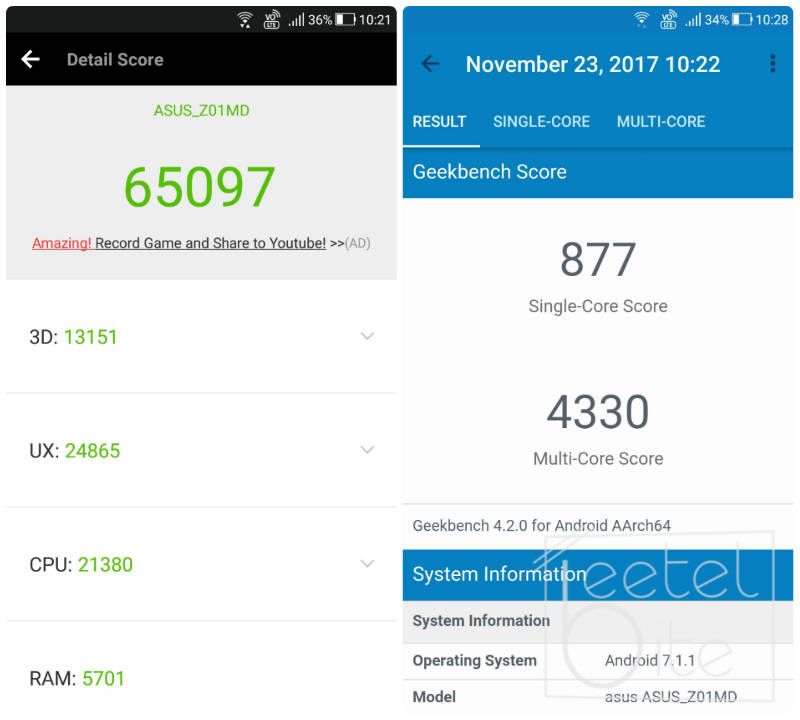
We ran our usual AnTuTu benchmarks and the GeekBench benchmark to evaluate the performance of the phone. The AnTuTu yielded a score of 65097 which is impressive and the GeekBench yield a single core score of 877 and multi-core score of 4330. The performance numbers of the device on paper were good enough for the value.
The phone handles basic tasks like web browsing and facebook WhatsApp and Snapchat real well.
Also, the device also handles heavy gaming such as Need For Speed: No Limits without any issue.
Display
The device has a good 5.5-inch(1080×1920) full HD AMOLED display with great sunlight readability with full brightness. The colours are very vibrant and vivid. The display is up to the mark. There is an outdoor mode for increasing the brightness to the highest possible for sunlight readability.The device also has an always-on feature but as it doesn't have an OLED display, the whole display is kept on during that and it impacts battery way much.
Camera
The Asus Zenfone 4 Selfie Pro has a dual camera setup at the front with a wide angle lens for wide-angle shots to cover more in one image and a telephoto lens. The setup is a 12-megapixel plus 12-megapixel f/2.0 aperture in the front and a 16-megapixel f/2.0 aperture at the back.
The indoor shots with adequate lighting are great with good light exposure and focus. The exterior shots also show the same characteristics with the sunlight shining brightly. This makes the rear 16MP f/2.0 aperture camera look good. Also, it offers some stability in the images when the hands are moving. There is a software-enabled rear portrait mode but it needs adequate lighting and stability and time to process. Also, it looks like its software-based so we won't recommend using it. The lowlight camera is also really good.
LowLight with Flash
LowLight without Flash
Obviously is called the Asus Zenfone 4 Selfie Pro, meaning its a selfie-focused device so that's the most important part of the phone. The one thing we keen on testing was that 24 MP DuoPixel camera technology which Asus said to the best in the industry. It's basically two 12MP camera sensors combining to provide a seemingly 24MP photo. Also, there is a wide-angle mode for the front snapper.
WideAngle
24MP DuoPixel
The wide angle mode does what it says with a good 12MP wide-angle camera taking photos which is better than many phones back camera like the Infocus Turbo 5 Plus. The 24MP DuoPixel magic happens when you go into camera setting and turn on the 24MP DuoPixel checkbox. The front cameras are able to capture photos in high resolution with an incredible amount of information with perfect white balance and surprising depth. This can be used to take selfie portrait photos with great quality if Asus chooses to enable it in a future update. It gets full approval for the being the selfie phone.
Battery
Packing a 3,000mAh battery the phone lasts almost a day with the need for charging at the night with constant usage and mild gaming. The charging time with the included charger is around two and a half hours which is pretty standard for the included 2 amp charger.
PC Mark Work 2.0
We ran the PC Mark’s Work 2.0 Battery Life test which subjects the phone to heavy usage and finds out the battery life in that condition. The device yielded a result of 9 hours and 38 minutes which is up to the mark of these smartphones. The battery could better but that was the needed to make the super light and thin phone. Depending on the personal choice the compromise turned out to be good.
Conclusion
The Asus Zenfone 4 Selfie Pro comes with a price tag of Rs. 23,999 and performs great in all the segments. But that being said we felt the phone is a bit more expensive than what it should be. If the device cost somewhere around Rs. 20,000-21,000 or less the Zenfone 4 Selfie Pro would have been a great phone to own. Also with the 2017 trend of shrinking bezels and 18:9 resolution display the device looks kinda out-dated. If your primary focus is a camera or the selfies this is the device to purchase but if you looking for an all-rounder phone we think its a little expensive. That being said the included high-quality case in the box justifies the price a bit but not that much. With the discounts of various sales, if you can get this phone for Rs. 21,000 or less, this is the perfect phone for one to purchase.
LG, the South Korean giant, is now gearing up to launch the much anticipated LG V30+ in India. The smartphone was first unveiled at the IFA 2017 in Berlin. The smartphone is a premium flagship offering from the company and competes directly against other premium smartphones like the Samsung Galaxy Note 8 and the Apple iPhone X. LG is now finally bringing the device to India by holding an event in New Delhi on December 13 for which the company has rolled out the media invites.
Earlier reports suggest that the smartphone is expected to launch at a price of Rs. 47,990. Is this comes true, it will bring a really tough competition to the likes of Samsung, Apple and Google. The LG V30+ comes with flagship like specification with a bunch of premium features.
The LG V30+ is powered by the Qualcomm Snapdragon 835 SoC coupled with the Adreno 540 GPU. The smartphone sports a 6-inch POLED display with a resolution of 1440x2880 pixels and an 18:9 aspect ratio. The V30+ packs in 4GB of RAM coupled with 128GB of onboard storage which is further expandable up to 256GB using a microSD card. The device runs on Android 7.1.2 Nougat with LG's UX 6.0+ skin layered on top of it. The phone is backed by a 3,300mAh battery.
On the optics front, the LG V30+ features a dual-camera setup at the back consisting of a 16-megapixel sensor combined with a 13-megapixel sensor with phase detection and laser autofocus and a LED flash. Up front, there is a 5-megapixel selfie camera with f/2.2 aperture.
Honor on Tuesday launched two new smartphones with 18:9 aspect ratio displays. The mid-range Honor 7X has been launched to bring a successor to the popular Honor 6X. The 7X brings a display with minimal bezels and a dual-camera setup at an affordable price. The company also launched the Honor View 10 which is a flagship offering. The View 10 will directly compete against the likes of OnePlus 5T, Nokia 8 and the Xiaomi Mi Mix 2.
Honor 7X
As far as the specifications are concerned, the Honor 7X features a 5.93-inch IPS LCD display with a resolution of 1080x2160 pixels and an aspect ratio of 18:9. The smartphone is powered by the HiSilicon Kirin 659 SoC which is an octa-core processor. The device packs in 4GB of RAM coupled with either 32GB of storage or 64GB of onboard storage. The storage on both the variants is expandable up to 256GB using a microSD card. The Honor 7X runs on EMUI 5.1 based on Android 7.0 Nougat. Under the hood sits a 3,340mAh battery powering up the internals.
On the optics front, the Honor 7X sports a dual-camera setup at the back consisting of a 16-megapixel sensor coupled with a 2-megapixel sensor. Up front, there is an 8-megapixel front-facing camera for selfies and video calling. The device also features a fingerprint scanner that sits below the camera setup at the back.
The Honor 7X is launched at a price of Rs. 12,999 for the 32GB variant while the 64GB variant will retail for 15,999. The smartphone will go on sale exclusively via Amazon India starting December 7, 12 noon.
Honor View 10
Being a flagship, the Honor View 10 comes with an impressive spec sheet. The Honor View 10 sports a 5.99-inch IPS LCD display with a resolution of 1080x2160 pixels and an 18:9 aspect ratio. The smartphone is powered by the Hisilicon Kirin 970 chipset coupled with the Mali-G72 MP12 GPU. On the storage front, the device comes with 128GB of internal storage combined with 6GB of RAM. The Honor View 10 runs on EMUI 8.0 based on Android 8.0 Oreo out of the box. The smartphone is backed by a 3,750mAh battery which supports fast-charging via USB Type-C.
In the camera department, the Honor View 10 sports a dual-camera setup at the back consisting of a 16-megapixel sensor combined with a 20-megapixel sensor. The smartphone also comes with a 13-megapixel selfie shooter with f/2.0 aperture.
The Honor View 10 is currently launched in Europe at a price of EUR 499 which roughly converts to Rs. 38,000. The smartphone will make its way to the shelves at the Indian markets by January 2018.
Google, on Friday, announced the Google Play’s most popular apps, games, music, movies and books in 2017 in India. As the year comes to an end, Google analyses which of its things were downloaded or purchased the most in the year via their Google Play services.
Most Popular Apps of 2017
Photo Editor - Beauty Camera & Photo Filters
Messenger Lite: Free Calls & Messages
Selfie Camera - Beauty Camera & Photo Editor
ALTBalaji
Paytm Mall: Online Shopping
Most Popular Games of the Year
Baahubali: The Game
WWE Champions Free Puzzle RPG
Super Mario Run
Dr. Driving 2
Pokémon Duel
Best selling books of 2017
An Unsuitable Boy, by Karan Johar
India 2017, by New Media Wing
Khullam Khulla: Rishi Kapoor Uncensored, by Rishi Kapoor
I Do What I Do, by Raghuram G. Rajan
Adiyogi: The Source of Yoga, by Sadhguru
Most Purchased Movie of 2017
Dear Zindagi
Moana
Wonder Woman
The Boss Baby
Doctor Strange
Most Streamed Songs of the Year
Saahore Baahubali, by M.M. Keeravaani
Ik Vaari Aa, by Arijit Singh
Mercy, by Badshah
Main Tera Boyfriend, by Arijit Singh
Cheez Badi, by Neha Kakkar
Apart from what got popular on India's Google Play, the company also revealed the applications, games, songs, movies, TV shows and books that got popular globally.
Xiaomi, the Chinese tech giant, recently unveiled their entry-level Redmi 5A in India at a really aggressive price. The company is now gearing up to launch two new smartphones, the Redmi 5 and Redmi 5 Plus in their home country. The devices will be unveiled in China on December 7 and might make their way to other markets soon. Just like most of the smartphones, these also have surfaced online just before the launch.
Xiaomi’s global spokesperson, Donovan Sung has posted the official images of the upcoming devices on Twitter, ahead of launch. Sung might have taken this move to keep the public excited about the upcoming budget-oriented devices. The images of the devices reveal that they will sport an 18:9 aspect ratio display making them the first budget smartphones by Xiaomi to enter the minimal bezels game.
Is everyone ready for the all-new Redmi 5 and Redmi 5 Plus? We're launching these two new devices in China on Thursday Dec 7. Giving everyone a sneak preview! ? #Xiaomipic.twitter.com/ESbaejpTJV
As the display is now 18:9 and there are minimal bezels, the fingerprint scanner sits on the back right below the camera setup. Although images do not reveal the specifications, we had a glance at them when the Redmi 5 was leaked on TENAA. As per TENAA, the Redmi 5 will sport a 5.7-inch HD+ FullView display and will be powered by the Qualcomm Snapdragon 625. The device is said to pack a 4GB of RAM along with 64GB of onboard storage. The smartphone will run on MIUI 9 based on Android 7.0 Nougat out of the box.
The Redmi 5 Plus, as the name suggests, will be the larger variant sporting a 5.9-inch full HD+ display. The smartphone will be powered by the same Snapdragon 625 chipset. The device is said to come with 3GB of RAM and 32GB of internal storage. Due to the larger display and footprint, the Redmi 5 Plus will carry a 4,000mAh battery which is significantly larger to the 3,300mAh battery on the Redmi 5.
We recently got to review the Piston Classic earphones from 1More which were really amazing. Today we have the 1More iBFree for review which is the company's foray into the wireless earphones for exercise market. These earphones provide a secure fit due to their water-resistant design. However, they do slip out of the ear occasionally. Let's find out how are the 1More iBFree Bluetooth earphones in this review.
Design
The iBFree is a pair of Bluetooth earphones designed for mainly sports activities. These are available in the colour options - Grey, Green, Blue, and Red (We got the Green versions for the review). Additionally, these come with IPX4 water resistance making the earphones resistant to sweat. The IPX4 rating also guarantees that the earphones will have a secure fit. Interestingly, you will have to try out all the ear tips and the wing tips inside the box to know which one suits you better, or you will have the earphones slip out of your ear a lot.
The earphones ship with three pairs of ear tips and wing tips in all small, medium, and large sizes. Due to these not being truly wireless the company has also provided a cable cinch in the box to adjust the amount of slack the earphones have.
The inline remote in all the three colour variants is Black in colour, this may be a design choice to get a regularity in the look of the earphones. Inside the in-line remote we get to see a three button setup to control the headphones along with a micro USB charging slot hidden inside a sealed compartment.
Performance
The 1More iBFree are hands down one of the best neck-band Bluetooth earphones we have tested out at Beetel Bite. These perform extremely well and have great sound output.
These were put to our regular tests we do on earphones. We used them with Android and iOS smartphones with a huge palette of musical genres. During the testing process, we found that these headphones were able to deliver all the highs, mids and the lows properly making the music listening experience much better. There was no muddled sound of any sort which would have made us take the earphones off during a workout.
The only let down on these were the volumes, they were crazy. If we heard music on these at more than 60 percent of the volume we would have bleeding ears. But due to us being reviewers we had to torture ourselves at full volumes, and surprisingly there wasn't any distortion at full volume.
1More claims that their iBFree can run up to 8 hours on a single charge. However, we would say it depends upon your usage patterns and styles. We were able to churn out 10 hours of music playback from these during the testing period with low usage style and minimal volumes, however, when we played at full volume and for extended hours the headphones were able to last us around 6-7 hours on a single charge. Full charging the device took around 2-3 hours.
Verdict
The 1More iBFree are a really good pair of earphones. They provide a good amount of bass along with a clear sound. If you workout they might just be the perfect fit for you. We loved these pair of Bluetooth earphones and would surely recommend them to you.
Google's Android operating system has been so popular and has become widely adopted. The people who can't afford a costly smartphone or just want to get their first smartphone, the entry-level phones running Android just fail in providing a smooth experience. Google released Android Go project and Android One project which helped in giving seamless software experience even on entry-level smartphones. The company has now introduced Android Oreo (Go Edition).
The Android Oreo (Go Edition) consists of three major changes: the operating system, Google applications and the Play Store. The operating system has been optimised in such a way that it can run smoothly even on phones with 512MB or 1GB of RAM. The operating system also takes up less space which means more room for media storage even on devices with 8GB of internal storage. The apps have been optimised in such a way that they perform 15 percent faster than on regular Android and the overall operating system gives 2X more available storage.
Android Oreo (Go Edition) will come with a bunch of Go apps pre-installed which include: Google Go, Google Assistant Go, YouTube Go, Google Maps Go, Gmail Go, Gboard, Google Play, Chrome, and Files Go. These applications have been tuned to take very less space as compared to their regular versions. Also, the Play Store on the Go Edition will have a recommended section where the apps which are tuned for entry-level devices will sit.
Meanwhile, Google has also started rolling out the stable version of Android 8.1 Oreo. The update should start hitting the Pixel 2, Pixel 2 XL, Pixel, Pixel XL, Pixel C, Nexus 6P and Nexus 5X devices soon. Users will not need to do anything and just wait for the OTA update notification.
Micromax, the Indian smartphone manufacturer, has launched another smartphone with an 18:9 display. The Micromax Canvas Infinity Pro is a successor to the company's recently launched Micromax Canvas Infinity. The smartphone will compete directly against the LG Q6. The highlights of the smartphone include the 18:9 display and the dual-camera setup up front.
Commenting on the launch, Shubhodhip Pal, Chief Operating Officer, Micromax Informatics said “We understand that in the mid-premium range smartphones, consumers demand a complete package – a smartphone that has best in class cameras, screen that is large enough for content viewing, battery that doesn’t drain in a day and of course aesthetics that are head turner. We truly believe that Infinity Pro is that package and our consumers will be delighted with the pricing as well. We are known to bring revolutionary products within the range of millions of Indians and this is another step in that direction.
“We are pleased that we are joining hands with Flipkart yet again as this would help us reach out to the young, hyper social consumers. With Canvas Infinity Pro, we ushered in a smartphone revolution and with the successor of the iconic smartphone, we aim to continue our pursuits to breach barriers and reach newer heights in our bezel-less revolution,” he further added.
Ayyappan Rajagopal, Senior Director - Mobiles, Flipkart, said, "We constantly strive to make best-in-class technology available to our customers through our seamless affordability programs and wide market reach. We are delighted to partner with Micromax to exclusively launch the new Micromax Canvas Infinity Pro. We are certain that this device will strengthen Micromax's portfolio on Flipkart by providing customers a great selection across various price segments."
Specifications
As far as the specifications are concerned, the Micromax Canvas Infinity Pro is powered by the Qualcomm Snapdragon 430 SoC. The smartphone features a 5.7-inch Full Vision display with a resolution of 1440x720 pixels and 18:9 aspect ratio. The device packs in 4GB of RAM and 64GB of onboard storage which is further expandable up to 128GB using a microSD card. Under the hood, there is a 3,000mAh battery powering up the hardware.
In the camera department, the Canvas Infinity Pro sports a 16-megapixel rear-facing camera with a LED flash. up front, the phone comes with a dual-camera setup consisting of a 20-megapixel and an 8-megapixel sensor for selfies. The smartphone also comes with a fingerprint scanner at the back for which the company claims an unlock time of 0.2 seconds.
Price and Availability
The Micromax Canvas Infinity Pro is launched at a price of Rs. 13,999. The smartphone will go on sale exclusively via Flipkart starting December 6, Mid-night onwards.