Mi Days Sale brings exciting offers on older phones like Redmi Note 6 Pro.
At the Xiaomi's Mi Days Sale, the smartphones will be sold at a cheaper price. The sale has started today, June 17 and it goes on until June 21 exclusively only on Amazon. During the sale, Xiaomi's smartphones and accessories will be sold with huge discounts. Amazon is also offering an additional 5% instant discount with Axis Bank debit and credit cards.
Here are some of the offers which are available on the Mi days sale:
Redmi Note 5 Pro
Xiaomi Redmi Note 5 Pro features an 18:9 display.
Redmi Note 5 Pro is one of the best selling Xiaomi phones in India. During the Mi Days sale, the company will be selling the Redmi Note 5 Pro for a price tag of Rs. 10,999. This price is for the base variant that comes with 4GB RAM and 64GB storage. There's a 6GB RAM + 64GB storage variant of the Redmi Note 5 Pro available for Rs 11,999 during the sale.
Redmi Note 6 Pro
Redmi Note 6 Pro comes with a notched display.
Redmi Note 6 Pro was the first Xiaomi phone to come with notched display in India. As a part of the sale, the Redmi 6 Pro is sold at the price of Rs 8,999 for the base variant that comes with 3GB RAM and 32GB storage. The 4GB RAM + 64GB storage variant of the Redmi 6 Pro is sold for Rs 9,999 during the sale.
Xiaomi Redmi Y2 sports a dual-camera setup at the back.
Xiaomi's Redmi Y2 for the selfie enthusiasts is selling at a starting price of Rs 7,999. In addition, with the two variants of the Redmi Y2, the 3GB variant and the 4GB variant, buyers can also get extra Rs 1000 off on exchange. Also, as mentioned earlier, buyers can also get a 5% instant discount on Axis Bank debit and credit card EMI.
Xiaomi Mi A2
Xiaomi Mi A2 is a part of Google's Android One program.
Xiaomi Mi A2's base variant starts at the price of Rs 10,999 in the Mi Days sale. This variant of the phone comes with 4GB RAM and 64GB storage. There's another variant which is 6GB RAM and 128GB storage model of the Mi A2 with a price tag of Rs 15,999. In addition, Amazon is also offering on Mi A2 Rs 3,000 and Rs 4,000 extra off on exchange for 4GB and 6GB RAM version respectively.
Redmi 6A
Redmi 6A is an entry-level smartphone from Xiaomi.
Redmi 6A starts with the price of Rs 5,999. This is for the base variant 2GB RAM + 16GB storage model. There is also a variant of 3GB RAM + 32GB storage at the price tag of Rs 6,499. Additionally, Redmi 6A buyers can get a 5% instant discount on Axis Bank debit and credit card EMI and also Amazon is offering Rs 500 cashback via Amazon Pay balance.
WhatsApp brings dozens of features to the table. Here's how to use them all.
WhatsApp, the popular cross-platform messaging application, comes with tons of useful features. However, most people are either not aware of them or they do not know how to make use of them. So, here we explain you the top five features that you should be using on WhatsApp.
WhatsApp Web
One of the best additions to WhatsApp in the features department has to be the WhatsApp web feature. As the name suggests, it allows users to send and receive WhatsApp messages right at the convenience of their desktops. While it was earlier accessible on the browser, the company has even rolled out dedicated apps for Windows and Mac PCs.
Group Invitation
When you are creating a huge group and do not want to annoy people, just send them group invitation links. If they are interested in joining the group, they can simply click on the link to join. Also, this feature can come in handy in situations where you want to add someone to a group without saving their number.
Screen Lock
Screen lock or more commonly known as App Lock has finally arrived on WhatsApp for iOS. While Android allows third-party app lock software, iOS users can simply lock their WhatsApp by enabling Scree Lock feature in Settings>Privacy. Once enabled, it will ask for Touch ID or Face ID verification every time you open the app. The feature is expected to arrive in Android soon.
Starred Messages
Just like other features on this list, the starred messages feature has been there for quite some time now. It allows users to star important messages from a conversation so that users can quickly find them when needed. This can especially be helpful when someone sends you tickets or important information that is needed later.
While most people have hundreds of contacts on their phones these days, it sometimes gets difficult to even find someone who we frequently contact. Now you can pin important conversations os that they remain on the top no matter how many messages you receive afterwards.
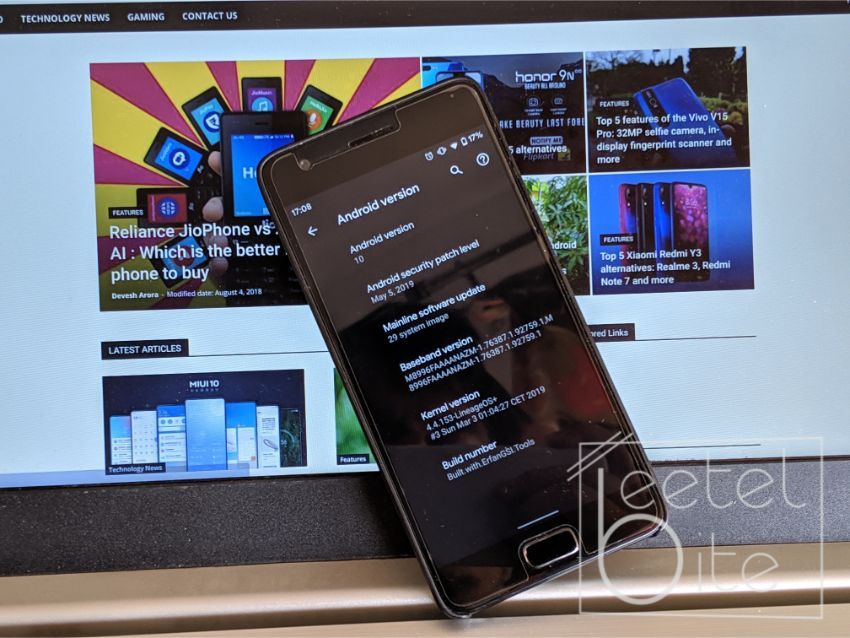
Google recently released the fourth beta of Android Q operating system. With that, the release of the Android Q is closer than ever. The update finalises the API's developers will use to develop apps for the latest version of Android and prepare their apps to run on Android Q when the stable version launches this summer. Right now you can try Android Q on phones that are eligible in the Android beta program or you can easily find Android 10 based beta ROMs ported on to phones outside Android beta program.
Here are the top 5 features that are coming with the latest version of Android as of this date.
Bubbles API
Android Q Bubbles Api for in call menu
Google is adding Bubbles API in Android Q. What this means is apps that easily show messages like the Facebook Messenger with the chat heads. The best part about is all of this will be done natively. That means the effort from the developer end will be minimal, and the load on the Android device will be minimal and the performance will be great. This will make things like messaging on Android so much more convenient.
As you can see in the attached images above, Bubbles is working with the Google Phone app. By leaving an active call, the bubbles API is triggered. bubble appears on the screen which can be used to quickly perform actions in call without going back to the call screen.
Wifi and QR codes
Android Q Wifi Share
Sharing your Wi-Fi network password when guests visit your home can be awkward. You might not remember the password or it may be too awkward to tell. With Wifi QR codes in Android Q you can easily share the Wifi with another person via a QR code. Just go on the Wifi settings, click on the connected wifi and then click on the share button. It asks for your password to make sure someone not intended cannot gain access to your wifi.
Location Control
Android Q Location Management
Android is finally getting more hold over how apps can use the user's location. Right now, its whether the app has the user's location data access or the app doesn't have that. With Android Q that's all gonna change. The user can choose the third option to only grant access to the location when the app is open. This works much like the location permissions in iOS.
Better Notification Controls
Android Q Notification Management
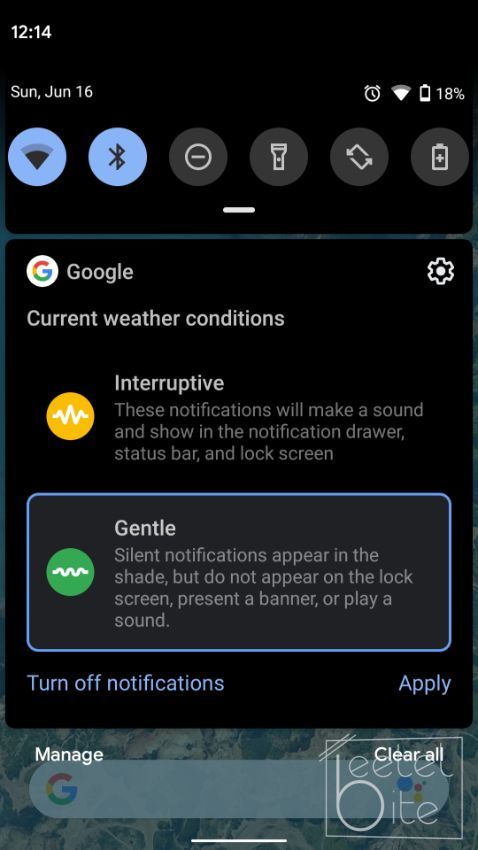
When you long-press a notification alert, you're now presented with two different options, Interpretive and Gentle. Selecting Interpretive will allow the app to make sound with each new alert, as well as place an icon in the status bar, like it used to work. Gentle will not make a sound, and its icon will not appear in the status bar up top.
Live Captions
In the quest to make Android more accessible, Google has added something that is called Live Caption. It will display live captions on the screen without the Internet connection or any video playing on the screen. Sadly, we weren't able to get this working now. However, is Google lives up to its promises, it will be one of the most important features of Android Q.
Xiaomi's Mi Community has decided to end support for the MIUI Global Beta program for all of its devices. For the unaware, MIUI is Xiaomi’s own heavily customisable user interface based on Android. The company has been releasing MIUI Global Beta ROMs for its community and developers for all of its devices, which helps them in supporting the development of MIUI according to the needs of its users.
In a recent Mi Community blog post, admin member Elaine2046 has declared that their team of engineers will stop releasing Global MIUI Beta builds for all of its devices effective from July 1.
Currently, there are two versions of the software; MIUI Stable and MIUI Beta. MIUI Stable version is also the final version of MIUI that is delivered to the public. On the other hand, the Beta builds are for the fans and developers, where they can access the features ahead of the public release, however, these beta builds come with a number of bugs.
According to the Mi Community, there are thousands of people who prefer to use the MIUI Beta build even on their daily drivers. MIUI focuses on the higher standard of the observation when it comes to the stability of public releases. They spend more time in this area on perfecting the stable releases of the software in its new devices instead of maintaining the beta build in an older version of their smartphones.
MIUI is not only used in the Xiaomi devices but is also quite popular amongst a huge number of users.
In the Mi community blog post, the company did not mention about MIUI's Chinese Beta program, so it is expected to remain constant. The Chinese Beta feedback program shall be enough to develop the Global Stable builds.
Huawei Mate 30 Pro might be the first smartphone to come with HongMeng OS.
Due to the US-China trade war, Huawei was recently banned from doing business with any US-based company. One of the biggest effects of the ban is that the company will no longer be able to use Google's services including Android on its smartphones. The Chinese smartphone manufacturer might have found the right solution and here's what HongMeng OS is all about.
What is Huawei’s HongMeng OS?
Huawei first thought of making their own independent mobile operating system back in 2012 as a secret project. Initially, the operating system was internally referred to as ArkOS. Since the ban was announced, the company is working hard to finish the project as soon as possible. It is being said that once the OS goes official, it will be called HongMeng OS in China while the other regions will call it Huawei Oak OS.
While Android itself is a part of Google, it is still an Open Source project. This means that anyone can just pick up the barebones and start building their own OS on top of it. Since Huawei is banned, they will not be able to use Google services like Google Play Store, Play Protect, Security Patches and much more.
However, they will be able to use Android applications using their own app store, currently known as Huawei App Gallery. As the apps are basically from Android, app developers need not work from scratch for a whole new operating system.
How will it beat Android?
According to a recent report, the HongMeng OS is almost 60% faster than stock Android. Due to such claims, other Chinese smartphone manufacturers like Xiaomi, Oppo and Vivo have started testing out the operating system on their smartphones. If Huawei is able to convince other companies to use the OS as well, almost half of the Indian market will be using the HongMeng OS based smartphones.
As of now, we cannot say if the new OS will be able to beat Android or not. What we can see is that Huawei is looking to give a tough competition to Google in terms of hardware as well as software.
OnePlus 6T has started receiving the Android Q Developer Preview 2 update.
Google recently announced the first Developer Preview of their upcoming operating system, Android Q at the Google I/O 2019. Now the company has finally started rolling out the Developer Preview 2 with tons of bug fixes and improvements. OnePlus has also rolled out the update for its OnePlus 6 and OnePlus 6T devices as they are a part of the Beta program.
While the update does not fix all the issues found on the first developer preview, it does bring a fair bit of changes on board. Although the company has not yet mentioned a changelog of the new DP2 update, they have mentioned what does not work on the phones for now.
Here's a list of things that won't work or cause issues.
Also, OnePlus recommends backing up your smartphone even if you are upgrading from DP1 to DP2 as that can wipe the data during the upgrade process.
OnePlus 6T Specifications
OnePlus 6T is powered by the Qualcomm Snapdragon 845 processor coupled with up to 8GB of RAM. The smartphone sports a 6.41-inch Optic AMOLED display with a resolution of 2340x1080 pixels. It comes with up to 256GB of onboard storage and runs on Android 9.0 Pie. Under the hood, there is a 3,700mAh battery.
On the optics front, the OnePlus 6T comes with a dual-camera setup at the back consisting of a 16-megapixel primary and a 20-megapixel secondary lens. Up front, there is a 16-megapixel selfie shooter.
Honor View 20 vs OnePlus 6T: The reflective back of the View 20 catches some attention no matter what.
OnePlus is known for putting out smartphones with flagship grade specifications for half the flagship price with a price to performance ratio, which no one can match. OnePlus 6T gives smartphones that are twice its price heavy competition.
Huawei owned Honor recently launched their latest mid-segment flagship. What's interesting is that the OnePlus 6T and the Honor View 20 cost exactly the same, making it a complicated choice.
So let's find out with a quick comparison, which is the smartphone is for you?
Honor View 20 vs OnePlus 6T: Design & Display
Honor View 20 flaunts a unique design with a 6.4-inch LCD display with a resolution of 2310x1080 pixels with a display cutout for the selfie camera. OnePlus 6T on the other hand sports an almost similar 6.41-inch AMOLED display with a resolution of 2310x1080 pixels and a waterdrop notch for the selfie camera.
Display cutout on the View 20 is quite distinguishable from the small water drop notches like that on the 6T.
Both the smartphones sport a metal glass sandwich design. The back of the View 20 sports a fingerprint sensor while the OnePlus 6T sports one under the display. The reflective paint job of the View 20 looks way better than the one on the 6T.
Overall, the look of the View 20 looks much fancier compared to the OnePlus 6T, which looks more classy. The design language on the OnePlus 6T is less simple with the View 20 opting for more of a crazy eye-catching design.
Honor View 20 vs OnePlus 6T: Software
Both the Honor View 20 and OnePlus 6T run Google's Android 9.0 Pie. The difference here is the UI skin these smartphones use. While the Honor View 20 is running Honor's Magic UI 2.0, the OnePlus runs Oxygen OS 9.
Honor View 20 offers a more customisable experience.
In terms of software, magic UI is a minor improvement over Huawei's EMUI with slight UI modifications and nothing more. The Magic UI offers various options like an inbuilt theming engine and aggressive battery management techniques.
Oxygen OS offers a much more smoother experience.
OnePlus offers OxygenOS, which is basically stock Android with a couple of useful features sprinkled on top. It is, hands down, one of the best Android user interfaces according to me. The performance is flawless and animations are smoother than any other Android phone out in the market.
While Honor's solution offers more customisability, OnePlus offers a much cleaner and faster solution.
Honor View 20 vs OnePlus 6T: Performance
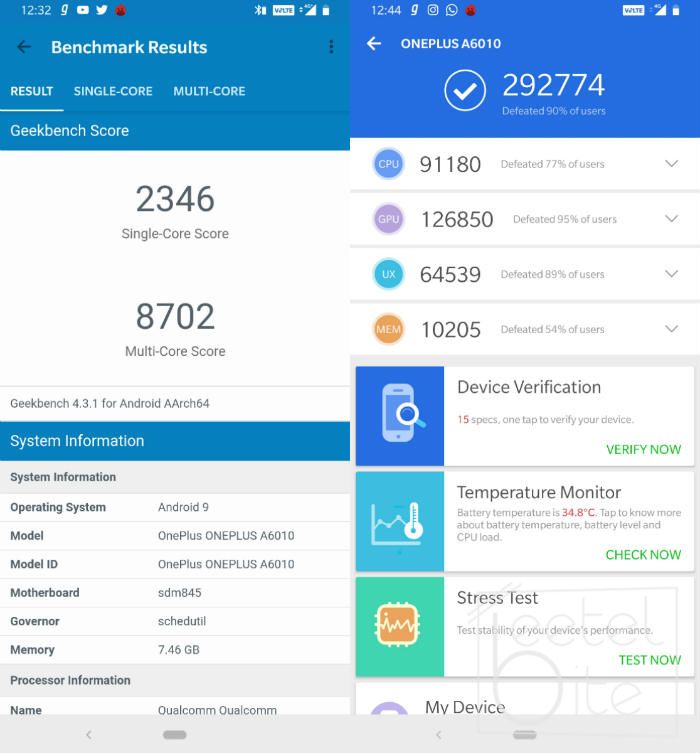
While the Honor View 20 is powered by the company's own HiSilicon Kirin 980 octa-core chipset, the OnePlus 6T comes with Qualcomm's Snapdragon 845 processor. Both the smartphones chew through any tasks thrown at them with ease. When numbers come into considerations, the 6T scores higher than the View 20 at 2,92,774 on AnTuTu, where OnePlus 6T gets a score of just 2,78,304. whereas the View 20 scores more than the 6T in Geekbench clocking a single-core score of 3285 and a multi-core score of 9679 compared to 2346 in single core and 8702 in multi-core of the 6T. However, it is worth noting that our review unit of the 6T was an 8GB RAM variant while the View 20 had only 6GB of RAM.
Honor View 20
OnePlus 6T
OnePlus 6T does perform better while performing day to day tasks like opening and closing apps as it has better software optimisations with faster animations while the View 20 shows a significance speed drop which is mainly due to slower animations and more bloatware in the system.
During things like gaming, GPU Turbo 2.0 on the View 20 allows it to offer a better and cooler gaming experience that the 6T.
Honor View 20 vs OnePlus 6T: Camera
Honor View 20 sports a primary 48-megapixel, f/1.8 aperture sensor along with a 3D ToF secondary depth sensor at the back. For selfies, it sports a 25-megapixel f/2.0 aperture sensor. While on the other hand, the OnePlus 6T sports a 16-megapixel primary sensor with an f/1.7 aperture and a 20-megapixel secondary sensor with an f/1.7 aperture on the back. For selfies, there is a 16-megapixel selfie shooter.
1 of 3
Honor View 20 (Left) vs OnePlus 6T (Right)
Honor View 20 (Left) vs OnePlus 6T (Right)
Honor View 20 (Left) vs OnePlus 6T (Right)
The photos from both smartphones are almost indistinguishable. Photos from the View 20 offer a brighter and sharper output with more details due to the presence of a 3D Time of Flight (ToF) sensor at the back.
While images from the OnePlus 6T offer a much more natural output with better contrast. The night mode on the OnePlus 6T is definitely better. The front camera of the 6T offers slightly better photos with more colour accuracy than the View 20.
Honor View 20 vs OnePlus 6T: Battery
Honor View 20 packs a 4,000mAh battery while the OnePlus 6T settles for a smaller 3,700mAh battery. In our daily usage, the battery life of both the smartphones was almost equal.
Both phones easily lasted one full working day without much hesitation. Also, the Super Charge on the View 20 charges the phone at the same speed as the OnePus 6T's Dash Charger.
Honor View 20 vs OnePlus 6T: Conclusion
In the end, no smartphone is a clear winner here.
OnePlus 6T and Honor View 20 start at Rs. 37,990.
OnePlus 6T offers great performance for the price and brings in a decent camera setup with great software. While the View 20 offers amazing gaming performance with a unique design that catches the eye.
So in the end, which smartphone is the perfect choice for you depends on your personal preferences.
Xiaomi's sub-brand Redmi recently unveiled its first flagship smartphone in China, the Redmi K20 Pro. Along with the Pro version, the company also launched a regular Redmi K20 with toned down specs. Both the smartphones are finally making their way to India and will be up for grabs sometime in mid-July. But what does this mean for the future of Poco?
Xiaomi started another sub-brand called Poco or Pocophone and the first phone was called the Poco F1. With this brand, the company aimed at bringing flagship grade hardware at reasonable rates. Since the Redmi K20 Pro is now coming to India and it is expected to price somewhere around Rs. 25,000, we cannot see a bright future for Poco.
Although it might seem Poco has reached its dead end, the company might use the sub-brand to bring a cheaper flagship than the Redmi K20 Pro. While the K20 Pro comes with all the gimmicks like pop-up selfie camera and an in-display fingerprint scanner, the Poco F2 might skip on these in order to bring pure performance under Rs. 20,000.
Redmi K20 Pro Specifications
The recently launched flagship smartphone is powered by the Qualcomm Snapdragon 855 processor coupled with up to 8GB RAM. The Redmi K20 Pro sports a 6.39-inch Super AMOLED display with a resolution of 2340x1080 pixels. It runs on Google's Android 9.0 Pie operating system. All of this is backed by a 4,000mAh battery.
As for the optics, the flagship smartphone features a triple camera setup at the back consisting of a 48-megapixel primary, an 8-megapixel telephoto and a 13-megapixel ultrawide angle lens.
Google Pixel 4 and iPhone 11 are expected to feature a similar design language.
We have witnessed some really amazing smartphone launches since the beginning of 2019 like the OnePlus 7 Pro and Samsung Galaxy S10. However, there are still a few flagships that we are eagerly waiting for. From the Google Pixel 4 to Samsung's upcoming Galaxy Note series, here are the top three smartphones launching in the upcoming months.
Samsung Galaxy Note 10
The Samsung Galaxy Note 10 is expected to come in three variants, namely, the Galaxy Note 10, Note 10 Lite and Note 10 Pro. All of these smartphones will be unveiled at the Samsung Unpacked event in August. These devices will also support 5G connectivity. According to the leaks and rumours, we can expect quad cameras, Android 10, In-display fingerprint scanner, a super-sized 6.7-inch AMOLED screen, Snapdragon 855, along with support for 45W charging.
Apple iPhone 11
Apple iPhone 11 is expected to launch in late September and it is being said that just like last year there will be three variants this time as well. These will be the iPhone 11, iPhone 11 Max and the more budget-friendly iPhone XR2.
Apple iPhone 11 and iPhone 11 Max will come with triple camera setups on the back.
The biggest ever update on iPhone 11 is Apple adopting a USB Type-C port for 2019 iPhones. Triple lens camera setup and dual camera setup for iPhone XR2 will also be exciting to see. Apple also announced its latest OS, the iOS 13 at WWDC, which will come pre-installed on the upcoming handsets. Further, the devices will be powered by the A13 chipset and come with a better Face ID recognization system. However, Apple Inc has decided not to introduce 5G connectivity to its upcoming devices until 2020.
Google Pixel 4
Google Pixel 4 Release Date is expected around October 2019. Pixel 4 has no notch in the display, thus bringing a truly bezel-less screen. There are a total of eight cameras on the phone, which include five on the front and three on the back.
The Pixel 4 and Pixel 4 XL are rumoured to come with the latest Snapdragon processors, dual sim and 5G technology, dual front-facing Boomsound stereo speakers, face unlock technology, wireless charging, water-resistance and much more. Also, the Pixel 4 and Pixel 4 XL are expected to sport a 5.8-inch and 6.5-inch Quad-HD AMOLED Displays respectively.
Lava Z62 is a successor to the last year's Lava Z61 and will run Google's Android 9.0 Pie operating system.
Lava, the Indian smartphone manufacturer has just launched a new smartphone in India, the Lava Z62. The company has also launched a new 'Throw your TV away' offer to go along with the new smartphone. Under this offer, it will be offering customers a chance to get a Lava Z62 in exchange for their old TV.
Lava Z62 is a successor to the last year's Lava Z61 and comes with features like a 6-inch full view display, 8-megapixel back camera and a 3,380mAh battery.
It is priced at Rs. 6,060 in India for the sole 2GB RAM/16GB storage variant. The device will go on sale starting June 18 at 10 am, with the 'Throw your TV away' offer also going live. However, this offer will be available as first come first serve and will be available till stocks last.
Lava Z62 sports a 6-inch Full View display. It is powered by the MediaTek Helio A22 processor paired with an IMG PowerVR GE8320 GPU. The device will come with 2GB of RAM along with 16GB internal storage expandable up to 256GB via a microSD card. It will run Google's Android 9.0 Pie operating system. All of this will be backed by a 3,380mAh battery.
Coming to the camera specifications, the device sports an 8-megapixel sensor on the back paired with an LED flash module. On the front, it features a 5-megapixel sensor paired with an LED flash to take selfies.
The company also states that the device comes with a number of camera modes. These modes include an AI Photo Studio and Professional Mode.