Netflix, the popular streaming service is now testing out a new mobile-only subscription plan. The new Rs. 250 plan will be specially tailored for India where people currently hesitate to subscribe for the service as the current plans start at around Rs. 500. However, in order to bring the price down the company will add some limitations.
As of now, the company is only testing the plan and it might roll out sometime in Q2, 2019. In terms of the limitations, the new Rs. 250 plan on Netflix will only be available on mobile devices, which means users will not be able to watch their favourite shows or movies on TV, laptop or other streaming devices. Further, the content will only stream in SD (Standard Definition) and not on HD or Ultra HD. However, considering the plan in mobile-only anyways, it should be fine as SD looks quite good on smaller displays.
According to a report by Gadgets360, Netflix commented “We are always looking for ways to make Netflix more enjoyable and accessible. We will be testing different options in select countries where members can, for example, watch Netflix on their mobile device for a lower price and subscribe in shorter increments of time. Not everyone will see these options and we may never roll out these specific plans beyond the tests.”
Currently, the company has three different plans available, Basic, Standard and Premium, which come in at a cost of Rs. 500, Rs. 650 and Rs. 800 respectively per month. All three plans offer unlimited movies and TV programmes, anytime cancellation and first month free. With these plans, users can stream on their laptop, TV, phone and tablet. While the Basic plan brings only SD content, Standard and Premium plans offer HD and Ultra HD experience respectively.
10.or (Tenor) D2 is supposed to be an affordable sub Rs. 7000 smartphone offering great performance all round. However, it's not the ambition, that makes a smartphone great, it is the performance that it offers. 10.or D2 sports decent internals for its price but does it live up to the ambition of the company? Let's find out.
10.or D2
10.or D2 comes with a 1.40 GHz Qualcomm Snapdragon 425 coupled with an Adreno 308 GPU and 2/3GB of RAM depending on the variant you choose. It sports a 5.45-inch (1440 x 720 pixels) LCD display. For optics, it features a 13-megapixel rear sensor and an LED flash. For selfies, it packs a 5-megapixel front-facing camera. All of this is backed by a 3,200mAh battery.
The 10.or D2 sports a front flash
The device sports a plastic back panel with a cheap feeling plastic. It runs Google’s Android 8.1 Oreo with an almost stock look. The phone sports dual sim card slots, a dedicated microSD card slot, 3.5mm headphone jack and a micro-USB port for charging & data syncing. The company decided to remove the fingerprint sensor, which its predecessor 10.or D had. Instead, we get an 18:9 aspect ratio display and IPX2 rating, which at this price point is a hit and a miss.
Design
The 10.or D2 features a pretty cheap feeling plastic body design. The back is made out of a not so great feeling plastic with curved edges. The looks are also nothing fancy. The smartphone looks pretty basic with no unique design elements to distinguish itself. Considering the price point, if the phone performs well, we would take it.
The front has a 18:9 aspect ratio display
The device sports a 5.45-inch, 18:9 aspect ratio LCD display. Unlike most of the phones out there, it smartphone doesn't come with a notched display. The smartphone looks like a stretched out version of its predecessor. The speaker grille, a 5-megapixel front camera and the sensor array are all placed inside of the top bezel.
The back of the 10.or D2 has a speaker
On the back, there is a single camera module paired with an LED flash aligned in a horizontal orientation. The phone bears the 10.or logo at the back with the speaker grille at the absolute bottom of the back of the device. This is an interesting design choice because you cannot easily cover it with your hands, but when putting it down on a surface, like a table, doesn't mute the speaker completely too.
Top, Bottom, Left, Right in that order
On the right edge, there is the power button along with the volume rockers just above it. The left side only holds the sim card tray, which consists of two sim card slots and a dedicated micro-SD card slot. The top edge houses a headphone jack and the bottom edge houses the micro-USB port along with the primary microphone.
Overall the design of the smartphone is pretty basic and not many interesting design choices have been made while making this smartphone. The rear speaker grille and the removal of the fingerprint sensor might have been done to add the IPX2 rating to the device. The smartphone is not perfect, but it will pass for the money you spent on it.
Software
10.or D2 runs Google’s Android 8.1 Oreo with an almost stock android feel to it. The bloatware is kept to a minimum with the only pre-installed apps being all of the Amazon applications. Also, these apps cannot be uninstalled.
The sofware is almost stock
Overall, the stock Android experience is appreciated. It does remove many features like a built-in theme engine that companies like Oppo, Huawei and Asus offer. However, it offers a clean look which I personally can appreciate. Some people would appreciate this, whereas, others might hate it. That totally depends on one's preferences.
Performance
Performance is a major area of concern on any device, the 10.or D2 sports a 1.4 GHz Qualcomm Snapdragon 425 coupled with an Adreno 308 GPU and 2/3GB of RAM. We had the 3GB RAM variant, so your performance may differ with the 2GB one.
AnTuTu(left) , GeekBench (Right)
We ran our usual benchmark tests test to evaluate the performance of the phone. On AnTuTu, the device yielded a score of 45227, which is okay considering the price and competition. On GeekBench, it managed to get a single core score of 648 and a multi-core score of 1606. The performance numbers of the device on paper were not bad for the value. The phone exhibits occasional stuttering while heavy usage. In light usage the performance is smooth.
While playing light games such as Temple Run and Crossy Chicken, the phone runs smoothly. Considering the price range, you wouldn't wanna play any heavy games on this phone and if you do, the performance might not be so good.
Display
The LCD panel is quite bright
The 10.or D2 sports a 5.45-inch LCD display with a resolution of 720×1440 pixels. The brightness doesn't go down enough to protect your eyes from the bright light in pitch darkness. However, it manages to turn up by quite a lot, enough for having a good viewing experience under direct sunlight. The LCD panel will affect your battery usage, but it offers great sunlight readability, so its a much-appreciated trade.
Cameras
10.or D2 features a 13-megapixel rear sensor and a 5-megapixel sensor for selfies. The camera sensors are good on paper. Although, not everything depends on a camera's megapixel count as we have seen in the past.
Low Light IndoorIndoorIndoorIndoor
The rear camera of the 10.or D2 offers images with good details and great colour reproduction. The white balance capturing is also quite good considering its price.
Front Outdoor
The front camera of the 10.or D2 is a disappointment after looking at the rear one. The colours are out of balance, details are not as good as the rear camera and the sensor cannot focus properly.
Overall, the rear camera of the 10.or D2 out shadows the front camera.
Battery
10.or D2 comes packing a 3,200mAh battery, which lasts for a little over 24 hours on a single charge. The charge time with the included charger is around two hours which is not bad. Overall, you would like to charge the smartphone in the night before going to bed, so as to it doesn't die on you on your way to work in the morning.
The PC Mark Work 2.0 score of the 10.or D2 is a bit less
We ran PCMark’s Work 2.0 Battery Life test, which subjects the phone to heavy usage and finds out how the battery performs in those conditions. The device yielded a result of 9 hours and 53 minutes, which seems a bit low in comparison to similar battery capacity smartphones. We think it has something to do with that really bright panel.
Conclusion
The 10.or D2 is not the market killer but worth the money.
10.or D2 starts at Rs. 4,999 for the 2GB RAM variant and costs Rs. 5,999 for the 3GB RAM variant. The smartphone offers good performance with a clean, stock Android UI and a decent camera performance. However, the competition is tough and companies like Asus and Xiaomi offer much more performance for almost the same amount of money.
For now, the restriction is only on the mobile version of PUBG
While PUBG has become one of the most popular games worldwide, a lot of millennials are getting addicted to the game. A couple of addicted players have even been arrested. In order to counter such problems, Tencent Games and PUBG Corporation are coming up with a solution, which will restrict players to play the game for a limited time period. Here's how it works.
The restriction mode is available only for the Indian players. So the rest of the world can enjoy the game for countless hours. With this mode, PUBG sets a limit of six hours, after which the game will not be able to find new matches. Players will first be shown a warning first after. A second warning will pop up at four hours, stating that they are soon going to reach the limit. Finally, after six hours of gameplay, players will receive a "health reminder" and they will be asked to come back after 24 hours.
While the feature might be annoying for PUBG fans, it is quite helpful for the player's mental health. The feature comes only after the ban and arrests happened in Rajkot, Gujrat. Even China banned the game for players under the age of 13.
However, PUBG Mobile has not made any official announcement about the time restriction. The report comes after a random player faces restrictions for playing the game for more than six hours. Notably, the restriction is on per day basis. So, you can even play for four hours and then for another two hours later that day. The restriction time resets every 24 hours.
Vivo recently launched the Vivo V15 Pro smartphone in India. The mid-range device comes with plenty of exciting features including the 32-megapixel pop-up selfie camera, in-display fingerprint scanner and much more. Here's a list of top 5 features that make the Vivo V15 Pro a better option than the other phones in the price bracket.
1.) 32MP Pop-up Selfie camera
It comes with a 32-megapixel pop-up selfie camera.
Vivo V15 Pro comes with a 32-megapixel selfie camera, which can take much better and sharper images than some of its competitors. Additionally, the sensor houses inside a pop-up mechanism, which only pops out when needed. This helps in eliminating the need for a notch, thus offering a truly bezel-less experience.
2.) Ultra FullView Display
The device sports an Ultra Full View Super AMOLED display.
With the help of the new pop-up selfie camera, Vivo was able to achieve an Ultra FullView Display. There is no sort of notch or bezels hindering the display making content watching a mesmerising experience. It is an AMOLED panel, which brings deeper blacks and punchier colours making it even better for multimedia consumption.
AMOLED panel also allows for the Always-on-Display feature
In the race of making the bezels smaller, smartphone manufacturers started shifting the fingerprint scanners to the back of the smartphone. However, this resulted in inconvenience when the phone lies on a table top. So, with the V15 Pro, Vivo brings in an in-display fingerprint scanner. Also, it is a fifth-generation in-display fingerprint scanner, which not only unlocks faster but has a much better success rate.
4.) 48-megapixel primary camera
48-megapixel sensor is able to capture some great photos
One of the key features of the Vivo V15 Pro is the 48-megapixel camera at the back. It is responsible for taking great photos with a good amount of details. Vivo has also added a new wide-angle lens, which helps taking more things inside the frame. Additionally, the camera app brings a dedicated Night Mode making night shots look better.
Vivo V15 Pro looks attractive in the dual-tone colour finish.
While the Vivo V15 Pro is mostly about cameras and design, it does not lack behind in the specifications. It now comes with a Qualcomm Snapdragon 675 processor coupled with 6GB of RAM. This allows for a smooth gaming experience without any lag or hiccups. Additionally, the phone gets 128GB of onboard storage, which is further expandable using a dedicated microSD card slot.
Google finally brings Express backup to Google Photos in India
Google has added a new option in its Photos app called the express backup. The feature has now been made available to Android users in India. The feature was introduced back in December 2018 and it has now finally found its way to the Indian audience. In order to get the feature, the users must update the Google Photos application on their Android devices using the Google Play Store.
As the name suggests, express backup helps in backing up content faster. The feature is more useful in areas with bad internet connection. Unlike, High quality or Original quality backups, express backup takes backup of images and videos with reduced resolution allowing faster uploads even with slow data connections.
According to Google, the images saved using express backup are reduced to 3-megapixel resolution. Similarly, the videos are uploaded with a reduced resolution of just 480p. It also takes off closed captions and other information to reduce the file size.
Google Photos Express reduces the image resolution for faster uploads
Alongside the express backup feature, the company is also introducing a new Data Cap option. With Data Cap, users can set a limit of as low as 5MB for the daily backups. This feature will come in handy for users who have less data to play around with.
How to use Express Backup
First update the Google Photos using the Google Play Store
Once update, open up the app
Tap on the top left corner icon and head over to Settings
Now tap on Backup Sync and go to Backup Mode
Here you can switch to Express for faster backup
However, we highly recommend High Quality backup as with Express you will loose a lot of detail.
Redmi Go is one of the cheapest Android smartphones
Xiaomi's sub-brand Redmi has just launched its first Android Go powered smartphone in India, the Redmi Go. It is also one of the cheapest Android smartphones in the country with a price tag of Rs. 3,999. Here are some of the alternatives that one can consider before locking in the choice.
JioPhone 2
JioPhone 2 comes with a QWERTY keypad.
Though JioPhone 2 is not a smartphone, it is a feature phone that supports apps like Facebook and Whatsapp. The feature phone is available with a price tag of Rs. 2,999 and does support 4G and VoLTE. It also has a QWERTY keyboard.
iVoomi iPro
The back of the iVoomi iPro is made out of plastic.
Just like the Redmi Go, iVoomi iPro is also an Android 8.1 Oreo (Go Edition) smartphone. It sports a little more power under the hood than some of its competitors like Micromax Spark Go. However, it runs a skinned version of Android, which is not optimized enough. The device comes in with a price tag of Rs. 3,999.
Nokia 1 is one of the first smartphones to come with Android Go
While the Nokia 1 is a little more expensive than the Redmi Go, it does sport a better build quality. The Nokia 1 runs completely stock Android, which should help the experience and performance. It is powered by the MediaTek MT6737M processor. The smartphone comes in with a price tag of Rs. 4,999.
Lava Z50
The Lava Z50 was one of the first Android Go Edition smartphones to enter the Indian market. Just like the Nokia 1, the Lava Z50 also comes with a 4.5-inch IPS LCD display and the MediaTek MT6737M processor. Lava Z50 is up for grabs in the country for a price of Rs. 4,599.
Micromax Bharat Go
Micromax Bharat Go sports a 4.5-inch IPS LCD display. The smartphone is powered by the MediaTek MT6737M processor. It comes with 1GB of RAM and 8GB of onboard storage. The Micromax Bharat Go is available for a price of Rs. 4,399.
Currently, Poco F1 is one of the best value for money smartphones
Xiaomi is now gearing up to launch the successor to its already popular flagship Poco F1, the Poco F2. While there are tons of leaks and rumours about the device, very few tell the true story. Here's everything we know about the Poco F2 so far and what more to expect from the Chinese smartphone manufacturer.
With the Poco F1, Xiaomi brought flagship grade hardware for a relatively cheaper price point. The smartphone was built upon the Xiaomi Mi 8, which was launched in the Chinese market around four months before the launch of the Poco F1. Now that the Mi 9 is here, we can say that the Poco F2 might launch sometime in May 2019.
Since the Poco F1 was powered by the last year's flagship Snapdragon 845 chipset, the Poco F2 is most likely to come with this year's Qualcomm Snapdragon 855 processor. Just like last year, the upcoming smartphone is also expected to come in three variants, 6GB+64GB, 6GB+128GB and 8GB+256GB.
As for the optics, the Xiaomi Poco F2 will come with a triple camera setup at the back consisting of a 48-megapixel primary sensor, a 16-megapixel wide-angle lens and a 12-megapixel telephoto lens. Up front, the smartphone will have the same 20-megapixel selfie shooter with f/2.0 aperture.
As the Xiaomi Mi 9 comes with a waterdrop style notch, it is quite likely that the Poco F2 will sport a similar notched display. However, unlike the Mi 9, it might be an IPS panel and miss out on an in-display fingerprint scanner.
Redmi by Xiaomi has launched its latest entry-level smartphone, dubbed Redmi 7 in China.
Xiaomi's recently split sub-brand Redmi has launched a new entry-level smartphone, dubbed Redmi 7 in Beijing, China. Along with it, the company also launched the Redmi Note 7 Pro in China, which was launched earlier this month in India.
Redmi 7: Price, availability
Redmi 7 is priced at 699 Yuan (approximately Rs. 7,000) for the 2GB RAM/16GB storage variant. Whereas, the 3GB RAM/32GB storage variant is priced at 799 Yuan (approximately Rs. 8,000) and the 4GB RAM/64GB storage variant is priced at 999 Yuan (approximately Rs. 10,000).
The company hasn't revealed details about the international availability of the device as of now. It has been made available in Red, Blue and Black colour variants.
Specifications
Redmi 7 sports a 6.26-inch HD+ display with an aspect ratio of 19:9 thanks to the water drop notch design display. It is powered by the Qualcomm Snapdragon 632 processor paired with an Adreno 506 GPU.
The device comes with 2GB/3GB/4GB of RAM along with 16GB/32GB/64GB of internal storage. It also comes with a P2i coating for making it splash resistant. The device runs Google's Android 9.0 Pie operating system with the company's own MIUI 10 skin on top. All of this is backed by a 4,000mAh non-removable battery with support for 18W fast charging.
On the back, the device sports a dual camera setup consisting of a primary 12-megapixel sensor paired with a 2-megapixel secondary sensor. On the front, it features an 8-megapixel sensor for taking selfies.
Amazon Echo Dot 3rd Gen looks like a decoration piece for houses at first look.
When Amazon launched the original Echo Dot, it was an immediate success. It led the sales in the basic smart home speaker market. With a price tag of only Rs. 3500, it was an inexpensive way to get Alexa into your home.
However, Google immediately struck back with the arguably better looking and better sounding Google Home Mini. However, Amazon is back at it again with the Echo Dot 3rd Generation, bringing improvements to the speaker sound and at the same time to its looks also. However, is the change enough to demand the increased price tag? Find out in our full review.
Amazon Echo Dot (3rd Gen) Review: Design
Amazon seems to have taken a different approach when designing the new Echo Dot. The 1st and 2nd generation were more functionality driven, whereas the 3rd generation is more focused on the design. With the new Echo Dot, the size has increased, however, the design is way more good looking.
There are 4 microphones on the top.
The fabric on the side houses the speakers behind it.
The third-generation Echo Dot ditches the plastic sides of its predecessors for a cloth-covered finish. The top and bottom are made out of rubber instead of plastic. There are more rounded edges that make it look more like a household decoration piece rather than a smart speaker. This makes it easy for the Echo Dot to blend into your home, which is a major improvement. Rest of the design elements are the same. Also, the LED ring around the top is thicker.
Amazon has upped its game with the build quality of the 3rd Gen Echo Dot.
Like with the older Echo Dot, you can connect the new Dot to an external speaker via the 3.5mm audio jack or Bluetooth to amp up its sound. You can also play music through the Echo Dot using Bluetooth.
Amazon Echo Dot (3rd Gen) Review: Audio Quality
With its improved speaker, listening to music on the new Echo Dot is a way better experience compared to its earlier generations. One of the complaints we had with the older dot was that music listening experience was terrible, which is now solved with an upgraded speaker.
Google Home Mini's advantage over Echo Dot was its speakers.
That's the same advantage the Google Home Mini had over the Echo Dot. With this new generation, that difference is now thrown away out of the window. However, comparing the new Echo Dot to the full-size Echo will be a mistake as the latter one sports a subwoofer and a tweeter which the Dot lacks.
The Audio Quality difference is apparent as soon as you start doing anything. The newer Dot is much louder and clearer than the older dot. Also, it has better highs and lows. Vocals are also great on the new dot. This makes the new Echo Dot a good speaker with Alexa built in, instead of just an Alexa powered speaker.
Amazon Echo Dot (3rd Gen) Review: Alexa
The previous Echo Dot had seven mics to pick up your voice and did an amazing job at it. The new Echo Dot is more responsive than before, but this time it only comes with 4 microphones. We did experience a few ghost cases, when the speaker activated even when without calling out the hotword.
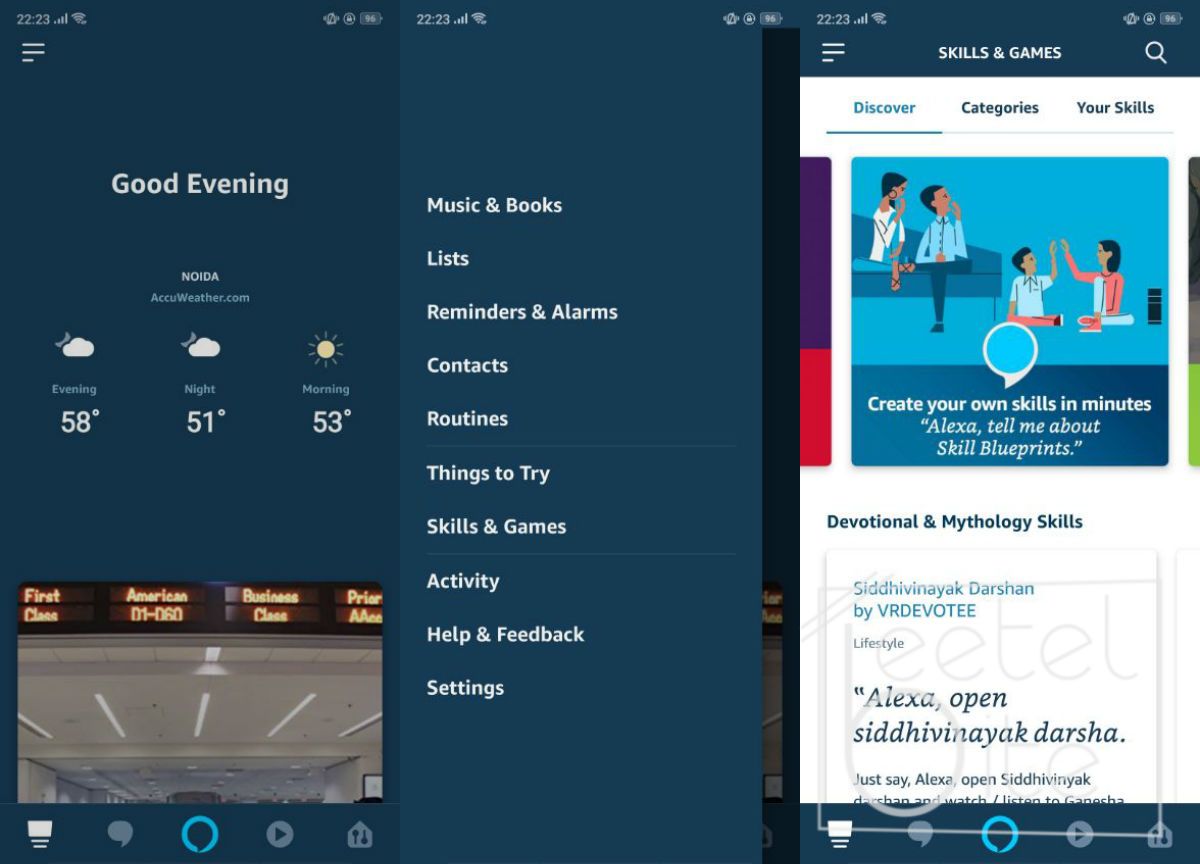
The Alexa App on Android, lets you customize your device and configure skills and more.
Alexa's abilities to perform various tasks keep on growing every day. With the ability for developers to integrate their apps with skills and Amazon developers working around the clock to make the experience better, there is nothing Alexa can't help you with.
The ability to use Alexa to call and message others, drop in on other Alexa devices, and broadcast a message to every Echo device in your home is particularly handy. However, it would be handy if we could link our smartphone to make calls to other people using our phone and not only Alexa to Alexa.
Also, the lack of an inbuilt streaming feature like the Google Home Mini makes you want to switch back to Google Home Mini.
Amazon Echo Dot (3rd Gen) Review: Conclusion
If you are thinking of investing in a smart speaker, Echo Dot 3rd gen is the way to go.
Amazon Echo Dot 3rd generation costs Rs. 4,499 which is Rs. 1,000 more than the 2nd generation. The Rs. 1,000 difference brings in a new improved design and a way better speaker.
The new Dot is not worth an upgrade from an older dot unless you really want the improved speaker and design. However, if you don't own the 2nd generation, the new Echo Dot is the best and the cheapest option to get Alexa in your home.
Tukshai vehicle will now finally be made available on PUBG Mobile stable release.
PUBG Mobile is currently running Season 5, which kicked off on January 21 and is finally coming to an end on March 18. The end of one season means the beginning of another one. Now, the company is said to launch the Season 6 starting March 21. Here's everything you need to know about the upcoming Season 6.
According to recent reports, the upcoming PUBG Mobile Season 6 will bring a new song, weapons, vehicles and more. The company has officially confirmed that a new song will be released as soon as the new season kicks off. As of now, the expected date for the release of Season 6 is March 21.
With the new update, PUBG Mobile will also receive a new weapon called G36C. It is an assault rifle that uses 5.56mm ammo and has great power and stability. The gun is also said to have less recoil and considering it uses 5.56mm ammo, it will be quite useful for mid-range fights. The gun will also be able to get some attachments like a scope, thumb grip, laser sight and more. However, the G36C will only be available on the Vikendi map.
Finally, PUBG Mobile will get the much-awaited Tukshai vehicle, which is more commonly known as an auto rickshaw in countries like India. Although it is not the fastest, it is quite fun to drive. The vehicle has been available on the PC version of the game for quite some time now. However, the vehicle is only available on the Sanhok map.
Apart from that, the new update will also bring new Avatars, Avatar frames and a new Badge for Royal and Elite passes. Reports also suggest that PUBG Mobile will finally get the dynamic weather in Erangel and Miramar maps.